Why Most Enterprise AI Agent Platforms Fail at Scale
Most enterprise AI agent platforms break when they hit production scale. Here's why and what a real-time decision engine does differently.
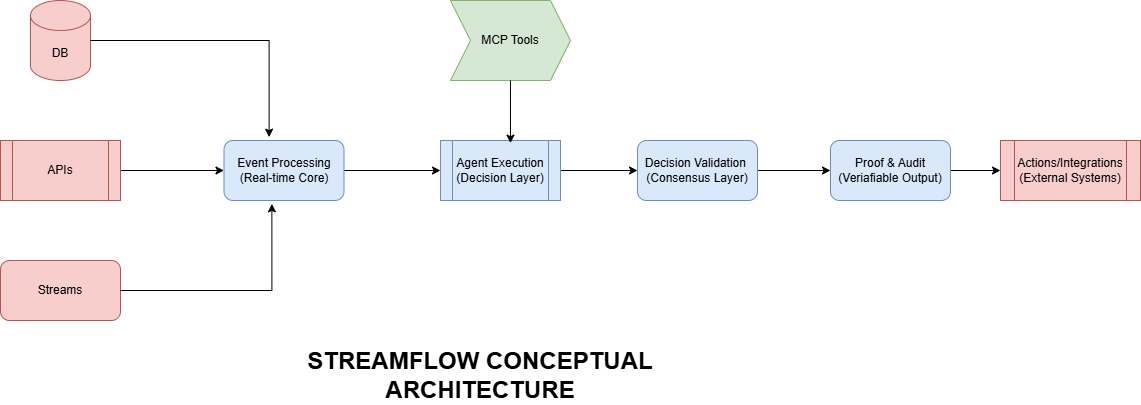
Most developers try to solve agent scaling by throwing more RAM and GPUs at the problem. They create a stateful instance for every agent, which works fine when you have ten agents. But what happens when you need 100,000 agents coordinating across a global logistics network?
The memory footprint becomes a nightmare. Traditional agent frameworks keep the entire conversation history and state "hot" in memory. In a high-throughput environment, this leads to a catastrophic crash or costs that would make a CFO faint.
Think of it this way: you don't need a full-time employee sitting in a chair for every single task in your company. You need a system that can trigger the right expertise at the right microsecond and then disappear.
StreamFlow flips this model with its Stateless Agent Orchestration, powered by our Event Mesh Agentique. We've engineered a system that manages over 100,000 agents simultaneously with a near-zero memory footprint. We aren't just talking about a slight improvement; we're talking about 3.8 million operations per second. To put that in perspective, that's 10x faster than Kafka or Holoscan. When you're managing a Smart City's IoT coordination or a high-frequency trading floor, milliseconds aren't just a metric, they're the difference between success and a total system collapse.
The Scaling Wall: Why "More Compute" Isn't the Answer
Most developers try to solve agent scaling by throwing more RAM and GPUs at the problem. They create a stateful instance for every agent, which works fine when you have ten agents. But what happens when you need 100,000 agents coordinating across a global logistics network?
The memory footprint becomes a nightmare. Traditional agent frameworks keep the entire conversation history and state "hot" in memory. StreamFlow flips this model entirely—managing over 100,000 agents simultaneously with near-zero memory footprint, leveraging our Stateless Agent Orchestration.
The Hallucination Tax in Regulated Industries
In a creative writing app, a hallucination is a quirk. In FinTech, it's a regulatory disaster. If an AI agent decides to approve a suspicious AML transaction because it "felt" the pattern looked okay, you don't have a feature; you have a lawsuit.
The problem is that LLMs are probabilistic, not deterministic. They guess the next token. But enterprise decision-making requires certainty.
The real question is: how do you get the reasoning power of an LLM without the risk of it making things up?
The answer isn't more prompting or better "guardrails." You need a consensus-based validation layer. StreamFlow eliminates hallucinations by requiring multi-agent consensus validation before any decision is executed because no single agent can act alone. If the agents don't agree based on the validated data, the action doesn't happen.
Beyond just stopping the error, we provide 100% auditable decision trails. When a regulator asks why a specific fraud alert was triggered at 3:00 AM on a Tuesday, you don't give them a "the AI thought it was suspicious" answer. You give them a deterministic map of the decision process.
The "One-Tool" Fallacy
There is a dangerous trend in the industry to believe that LLMs should do everything. Using a massive LLM to check if a temperature sensor is over 100 degrees is like using a Boeing 747 to drive across the street to get a coffee. It's overkill, it's slow, and it's expensive.
A real-time decision engine like StreamFlow doesn't rely on a single model. It uses a hybrid approach:
- Rule-based agents for lightning-fast, deterministic checks.
- LLMs for complex reasoning and nuance.
- MCP (Model Context Protocol) agents for standardized tool integration.
- Streaming agents for continuous data analysis.
Imagine a self-healing supply chain. A rule-based agent detects a port delay. An LLM analyzes the geopolitical reason for the delay and suggests three alternative routes. A streaming agent monitors the cost of those routes in real-time. StreamFlow's PVCS Protocol then validates the best option through consensus and executes the reroute.
Moving from Chatbots to Decision Engines
The industry is currently obsessed with "Chatbots." But the real value isn't in talking to your data; it's in letting your data make decisions.
If you are building for a regulated industry, such as FinTech, Logistics, or Smart Cities, you cannot afford a "probabilistic" infrastructure. You need a system like StreamFlow that scales linearly, executes with deterministic precision, and leaves a paper trail that would satisfy any auditor on earth.
Stop trying to patch together a series of fragile LLM calls and start building a real decision engine.
Ready to see what 3.8 million decisions per second looks like? Let's talk.
Passer à la pratique
Voyez la boucle observe → décide → agit sur un flux réel
Quelques minutes, sans installation ni inscription. Pulse est gratuit et auto-hébergé.